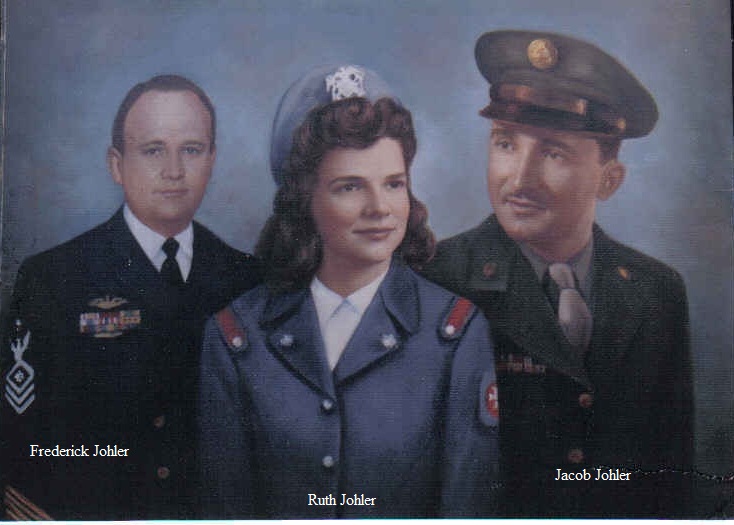
Thoughts from the blog author, Dorothy, the youngest daughter of the late Jacob and Marie Johler
Today is April 2, 2014. As I was working on this blog I came across something I wrote on May 11, 2010.
Witnessing
In 2002, our church was putting a Lenten Devotional. I had just finished reading a book called Give Us This Day by Sidney Stewart.
As uncomfortable as it may be to witness, let this true story inspire us and give us the courage to witness .
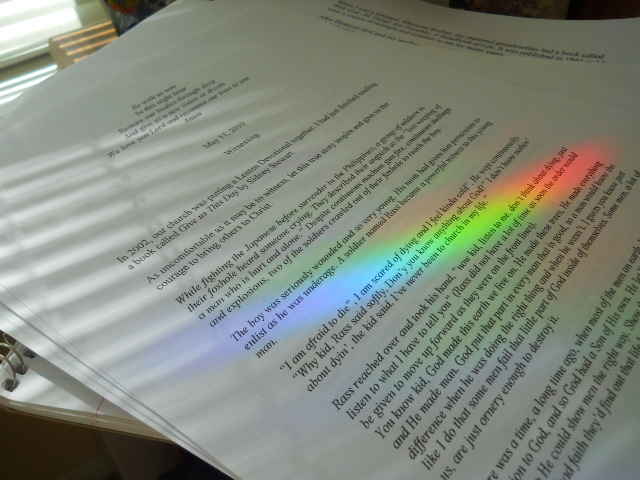
I regret that today I am unable to locate the book for proper page numbers and correct citation for the pasage I am using here. It is is packed in one of the many boxes of books, letters and notes that I have been working through for many years. We have moved several times and it is a challenge to keep this all together and organized as we pack and unpack. I would like to thank the author and publisher for permission to share the following. I decided to post today because there was a rainbow across the page from a prism my husband purchased for me. They appear often when I am working on this material to encourage and guide. Additionally, I apologize for any typographical errors.
Sidney Stewart wrote:
While fighting the Japanese before surrender in the Philippines, a group of soldiers in their foxhole heard someone crying. They described their anguish as the “lost weeping of a man who is hurt and alone.” Despite continuous machine gun fire, continuous shellings and explosions, two of the soldiers crawled out of their foxholes to reach the boy.
The boy was seriously wounded and so very young. His mom had given him permission to enlist as he was underage. A soldier named Rass became a powerful witness to this young man.
“I am afraid to die, I am scared of dying and I feel kinda cold.” He wept continuously. “Why kid’, Rass said softly, Don’y know anything about God?” “I don’t know nothin’ about dyin’, the kid said, I’ve never been to church in my life.”
Rass reached over and took his hand, “now kid, listen to me, don’t think about dying, just listen to what I have to tell you,” (Rass did not have a lot of time, as soon the order would be given to move up forward as they were on the front lines.),
“You know kid, God made this earth we live on. He made these trees, He made everything and He made man. God put that part in every man that is good, so a man would know the difference when he was doing the right thing and when he wasn’t. I guess you know just like I do that some men fail that little part of God inside of themselves. Some men, a lot of us, are just ornery enough to destroy it.”
“There was a time, a long time ago, when most of the men on earth didn’t pay much attention to God, and so God had a son of his own. He let him be born, right here on earth, so he could show men the right way. Show them that as long as they believed in him and had faith, they’d find out that life here, this was just sort of preliminary. If we came through the test the right way, we would have a life forever, a good life, with no shells or pain or sorrow, a life when things are like you dream. He promised it kid. He said, ‘if you believe in me and believe in my son, ye shall have life everlasting,’ He said that in the Bible and the Bible is God’s book.”
“You ever walked and seen flowers blooming, and the buds coming out on trees? You didn’t have anything to do with those, did you? But there they are. Something made those possible and something never forgets. Every Spring, there they are. That’s God kid and he won’t forget you either. If you just believe, you’ll go where people are never tired or scared or hurt. It’s that simple, if you believe in God and you believe in his son, why you haven’t got anything to be afraid of. Dying means you’ve just passed the test.”
“The boy never took his eyes from Rass’s face and he had the look of a child. Rass cleared his throat and went on. It’s like winning a medal-like going home. The boy had a smile on his face. He was smiling up at Rass as though Rass had shown him something noone else ever had.”
“I am not afraid no more, he said. ” I am not afraid now.” He closed his eyes. Then his head fell over to the side. Someone yelled;
‘hey you guys, we gotta get movin, we gotta get going,’ “We fixed our guns and waited for the order.”


 Johlerpow and Zale et al.
Written
on April 2, 2014